
You receive a letter from the New York City Department of Transportation (NYC DOT). A pedestrian has tripped on a cracked flagstone outside your building. You are now liable for medical bills, legal fees, and a mandatory sidewalk repair in NYC. The clock is ticking.
This is not a rare scenario. New York City’s Local Law and Administrative Code places the burden of sidewalk maintenance squarely on the property owner, not the city. When violations pile up, you need more than just a handyman with a bag of cement. You need an experienced NYC sidewalk repair contractor who understands the complex interplay of concrete mix ratios, grade compliance, and expedited permitting.
We have spent over two decades mastering the science of urban pathways. In this guide, we reveal what separates a mediocre patch job from a permanent, DOT-approved solution. Whether you need NYC concrete repair for spalling steps or a full NYC sidewalk replacement for an entire block, this article will arm you with the knowledge to choose the right partner.
Let’s walk through the essential criteria, costs, legal traps, and the definitive list of top contractors who consistently deliver safe and smooth pathways.
Why Your Sidewalk is a Legal and Financial Ticking Clock
New York City is a city of 8.5 million footsteps. Every day, delivery bikes, strollers, high heels, and mobility scooters traverse over 12,000 miles of sidewalks. The wear and tear is relentless. But beyond aesthetics, a damaged sidewalk is a lawsuit waiting to happen.
The city’s violation removal system requires property owners to repair hazardous conditions within 45 days of notice. Failure to do so results in the city making the repairs and slapping a lien on your property, often at triple the market rate. This is where hiring a legitimate sidewalk repair contractor in NYC becomes not a luxury, but a legal necessity.
However, the industry is riddled with unlicensed “concrete cowboys” who offer low bids, pour thin overlays, and disappear when the first frost heaves crack their work. As a recognized NYC sidewalk repair contractor, we will teach you how to verify insurance, check for DOT permits, and demand proper sub-base preparation, because a sidewalk is only as strong as what lies beneath.
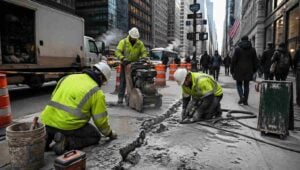
In the following sections, we will dissect the five most reputable contractors in the five boroughs, analyze the nuances of NYC concrete repair versus full replacement, and provide a step-by-step checklist for navigating the confusing world of NYC sidewalk regulations.
What Defines a Legitimate NYC Sidewalk Repair Contractor?
You must understand the legal and technical benchmarks that separate a professional NYC sidewalk repair contractor from a weekend warrior.
Licensing and Insurance (Non-Negotiable)
New York City does not have a specific “sidewalk contractor” license, but a legitimate firm must hold:
- General Liability Insurance.
- Worker’s Compensation and Disability Insurance (to shield you from liability if a worker is injured on your property).
- NYC DOT Permit (every single repair job over 5 square feet requires a separate permit).
Always ask for a Certificate of Insurance naming you as an additional insured. A top sidewalk repair expert in NYC will provide this without hesitation.
Technical Competence: Concrete Mix and Depth
Many cheap contractors use a 2-inch “broom finish” overlay that fails within one winter. A qualified NYC sidewalk repair contractor adheres to DOT specifications:
- Minimum 4-inch thickness for pedestrian walkways (6 inches for driveways).
- 6-bag concrete mix (5,000 psi) with air entrainment to resist freeze-thaw cycles.
- Proper joint spacing (every 4 to 6 feet) to control cracking.
The Importance of Sub-Base Preparation
The number one cause of premature failure is poor sub-base. A professional NYC concrete repair job involves removing all unstable material, compacting a 6-inch crushed stone base, and adding a vapor barrier if needed. Without this, even the best concrete will settle and crack.
Adherence to ADA Compliance
Sidewalks are not just flat slabs. They must have:
- Cross slopes no greater than 2%.
- Detectable warning domes at curb ramps (the yellow truncated domes).
- Flush transitions between panels (no vertical offsets over 1/4 inch).
An unreliable sidewalk repair contractor in NYC will ignore these details, leading to ADA lawsuits and forced redos.
NYC Concrete Repair vs. NYC Sidewalk Replacement: Which Do You Need?
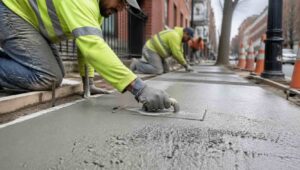
One of the most common questions we hear as an NYC sidewalk repair contractor is: “Can you just patch it?” The answer depends on the extent of the damage. Let’s break down the difference between NYC concrete repair and full NYC sidewalk replacement.
When to Choose NYC Concrete Repair (Spot Patching)
Repair is appropriate when:
- Less than 25% of a slab is damaged (corner breaks, spalling less than 1 inch deep).
- Cracks are smaller than 1/2 inch and non-structural.
- Uneven slabs (tripping hazards) can be ground down using diamond grinders (if the height difference is less than 1 inch).
Multiple patches on one slab create a “Frankenstein” sidewalk that looks unprofessional and may still fail under heavy loads.
When to Choose Full NYC Sidewalk Replacement
A qualified sidewalk repair contractor in NYC will recommend full replacement when:
- More than 50% of a slab is cracked or settled.
- Root damage from street trees has lifted the concrete (patch will simply re-crack).
- The sub-base has washed out (evidenced by hollow sounds when tapped).
- You want a uniform appearance for resale or leasing value.
The Process of NYC Sidewalk Replacement:
- Saw-cutting the existing slab to clean lines.
- Removing concrete and excavating 8–10 inches of soil.
- Compacting a 6-inch crushed stone (¾” minus) base.
- Installing rebar or wire mesh for tensile strength.
- Pouring 4–6 inches of air-entrained, 5,000 psi concrete.
- Finishing with a light broom texture (non-slip).
- Curing for 7 days (with wet burlap or curing compound).
A professional NYC sidewalk repair contractor will never skip the curing step. Premature drying causes surface crazing and reduces strength by up to 50%.
How to Avoid Scams and Low-Quality Concrete Work
The NYC Department of Consumer and Worker Protection receives over 200 complaints annually about sidewalk repair fraud. Protect yourself by following this verification checklist when vetting any sidewalk repair contractor in NYC:
The “Thin Overlay” Trap
Unscrupulous contractors will pour a 1-inch layer of resurfacer over an unstable slab. This looks good for 3 months, then delaminates. Always ask: “What is the minimum thickness you pour?” The correct answer is 4 inches for new slabs and 2 inches minimum for bonded overlay (only over a sound, cleaned substrate).
The Permit Lie
Some contractors claim, “You don’t need a permit for simple repairs.” This is false. NYC DOT requires a Sidewalk Repair Permit for any work that disturbs more than 5 square feet or changes the grade. A legitimate NYC sidewalk repair contractor will show you the permit before breaking ground.
No Written Warranty
Walk away from any contractor who offers only a verbal guarantee. Industry standard is a minimum 2-year warranty. NYC Sidewalk Repair offers a 5-year warranty on all full replacements because we use MIL-spec concrete mixes and triple-compacted bases.
Upfront Payment Demands
Never pay more than 30% upfront. The remainder should be due upon final inspection and sign-off. Legitimate firms have credit lines with material suppliers; they don’t need your cash to buy cement.
The Legal Landscape: DOT Violations and Your Responsibility
Understanding the legal framework is part of being an authoritative NYC sidewalk repair contractor. Here is what every property owner must know about sidewalk repair in NYC:
The 45-Day Rule
Upon receiving a DOT Violation (Form 7 or 11), you have exactly 45 days to hire an NYC sidewalk repair contractor and complete the repair. If you fail, the city will perform a forced repair and place a lien on your property.
The Sidewalk Inspection Program
Since 2019, the Department of Transportation (DOT) has used a fleet of GPS-enabled camera vans (the “Sidewalk Condition Assessment Vehicle”) to map every sidewalk in the five boroughs. If their AI detects a 1-inch vertical trip hazard, you will receive a notice within 30 days. There is no appeal on the data; you must repair.
Shared Responsibility with Tree Pit Sidewalks
If the damage is caused by a city-owned tree, you still pay for the repair. However, you can apply for the Tree Root Mitigation Reimbursement Program, which refunds up to 50% of NYC concrete repair costs related to root damage. A knowledgeable sidewalk repair contractor in NYC will help you file this paperwork.
Environmental Considerations – Sustainable Concrete Solutions
Modern NYC sidewalk replacement isn’t just about strength; it’s about sustainability. Forward-thinking contractors like NYC Sidewalk Repair are adopting green practices that reduce the carbon footprint of NYC concrete repair.
Permeable Pavers vs. Poured Concrete
For properties near drainage zones, permeable concrete (pervious pavement) allows rainwater to filter through, reducing stormwater runoff. While 30% more expensive upfront, it earns you a Green Infrastructure Grant from the NYC DEP.
Recycled Aggregate
Leading sidewalk repair contractor NYC firms now crush old sidewalk concrete on-site and reuse it as sub-base material. This keeps 5,000+ tons of construction debris out of landfills annually.
Cool Concrete
The NYC Cool Neighborhoods program encourages “high-albedo” concrete (lighter colored) to reduce the heat island effect. Ask your contractor about adding white cement or titanium dioxide to reflect UV rays and keep your sidewalk 15°F cooler in summer.
Maintenance Tips to Extend the Life of Your New Sidewalk
Even the best nyc concrete repair needs care. As a responsible nyc sidewalk repair contractor, we recommend:
- Sealing: Apply a breathable silane-siloxane sealer every 3 years to repel deicing salts.
- Avoid Rock Salt: Use calcium magnesium acetate (CMA) instead; rock salt accelerates spalling.
- Clean Joints: Weed and debris in expansion joints act as wedges, causing cracks. Clean them annually.
- Monitor Tree Roots: If you see new soil mounding, call a contractor to install a root barrier before the slab lifts.
Choose Experience, Choose Safety, Choose NYC Sidewalk Repair
Your sidewalk is more than a path; it is a public safety statement and a reflection of your property’s stewardship. Hiring the wrong NYC sidewalk repair contractor can lead to repeat violations, lawsuits, and financial loss. However, partnering with a firm that ensures that every pour, every joint, and every permit meets the highest standard of the NYC DOT.
We have walked you through the legal minefields, the cost breakdowns, the difference between NYC concrete repair and full NYC sidewalk replacement, and the red flags that signal a scam. Now, it is time to act.