
In the heart of New York City, where bustling streets and historic neighborhoods meet daily foot traffic, damaged concrete sidewalks pose serious risks to pedestrians and property owners alike. Concrete sidewalk repair in NYC is more than a maintenance task; it’s a critical step to prevent trip hazards, ensure ADA compliance, and steer clear of Department of Transportation (DOT) violations that can lead to liens, unexpected bills, and even personal injury liability. Whether you’re dealing with cracks from freeze-thaw cycles, uneven slabs lifted by tree roots, or settling due to poor subgrade preparation, timely professional concrete sidewalk repair in NYC keeps your property safe, compliant, and valuable.
Property owners across Manhattan, Brooklyn, Queens, the Bronx, and Staten Island share one legal reality: you are responsible for the sidewalk abutting your building. This comprehensive guide dives deep into concrete sidewalk repair in NYC, exploring regulations, common problems, expert repair methods, and practical steps to resolve issues before they escalate. You’ll discover why hiring licensed concrete contractors in New York delivers long-term value, how to locate reliable sidewalk repair near me options, and related services like curb repair in Brooklyn.
Why Concrete Sidewalk Repair NYC Matters More Than Ever in 2026
New York City’s sidewalks endure extreme weather, heavy pedestrian traffic, utility work, and urban tree growth. According to the NYC Department of Transportation, inspectors patrol neighborhoods regularly to identify defects under the Administrative Code. A single trip hazard as small as ½ inch or a crack that loosens a concrete flag can trigger a Notice of Sidewalk Violation.
These notices aren’t immediate fines; there’s no monetary penalty attached at issuance, but they carry serious weight. A copy is filed with the County Clerk, creating a public record that lingers until repairs are verified. Fail to act within the 75-day window, and the city can perform the work itself, bill you (often at higher rates), and place a lien on your property. Interest accrues after 90 days, and unresolved violations can block property transactions.
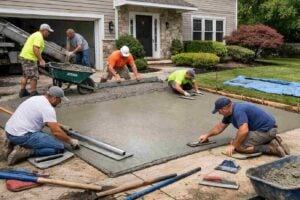
Concrete sidewalk repair in NYC addresses these risks head-on. Professional repairs restore full-depth concrete slabs to DOT specifications: 5-foot by 5-foot flags where feasible, 4-inch-thick concrete for standard sidewalks (7 inches under driveways), expansion joints every 20 feet filled with pre-molded material and sealed, and a precise ¼-inch-per-foot cross-slope toward the curb for proper drainage. In certain commercial districts (C4-4 through C6), pigmented concrete with saw-cut joints may be required for larger replacements.
Beyond compliance, expert concrete sidewalk repair in NYC prevents costly lawsuits. Section of the Administrative Code holds owners liable for injuries caused by defective sidewalks. A single fall resulting from an unrepaired trip hazard can lead to medical bills, lost wages, and legal fees far exceeding repair costs. Investing in quality sidewalk repair in New York protects your finances, your reputation, and the community.
Understanding NYC Regulations: The Legal Framework Behind Concrete Sidewalk Repair in NYC
Navigating NYC sidewalk rules requires clarity on responsibilities and timelines. Property owners must install, repair, reconstruct, and maintain sidewalks at their own expense. The code defines “substantial defects” with precision to ensure consistent enforcement:
- Missing or never-built flags
- Flags cracked such that pieces can loosen or be removed (full-depth cracks ¼ inch or wider, extending joint to joint)
- Undermined flags with visible voids or loose flags that rock
- Trip hazards: vertical differentials ≥ ½ inch between flags or surface depressions ≥ 1 inch wide and ½ inch deep
- Improper slope causing ponding or exceeding cross-slope standards
- Hardware (grates, cellar doors) protruding more than ½ inch or deflecting excessively
DOT issues a Preliminary Inspection Report (PIR) detailing each defective flag with a diagram. You have exactly 75 days from receipt (certified mail date or posting date) to begin compliant repairs. Weather delays in winter are considered, but the clock doesn’t stop; start as soon as conditions allow.
Permits are mandatory. A sidewalk construction permit costs a flat fee and covers administrative review plus the dismissal inspection. Licensed concrete contractors in New York typically handle permitting, saving you time and ensuring compliance. Any repair costing over requires a Department of Consumer and Worker Protection (DCWP) Home Improvement Contractor license; always verify via the DCWP database.
Failing the 75-day deadline triggers city intervention. The resulting lien appears on your tax bill, and payment plans are available only for eligible residential properties with charges.
This regulatory landscape makes the sidewalk repair contractor NYC expertise invaluable. Professionals understand the exact flag replacement requirements, joint specifications, concrete mix designs (per DOT Standard Highway Specifications), and finishing techniques that pass dismissal inspections on the first visit.
Common Issues That Demand Professional Concrete Sidewalk Repair in NYC
Urban environments accelerate concrete deterioration. Here are the most frequent problems requiring concrete sidewalk repair NYC:
- Cracks and Fractures Freeze-thaw cycles allow water to infiltrate, expand, and widen cracks. Thermal expansion in summer adds stress. Tree roots exacerbate the issue, pushing slabs upward. Cracks ≥ ¼ inch that span joints qualify as defects.
- Trip Hazards and Uneven Slabs Soil settlement, poor initial subgrade compaction, or root uplift creates vertical differentials as small as ½ inch, enough to trip pedestrians, strollers, or wheelchairs. Depressions from heavy loads or utility excavations compound the danger.
- Sunken or Missing Flags Voids beneath flags cause rocking or collapse. Undermined sections appear as visible gaps or hollow sounds when tapped.
- Improper Slope and Drainage Ponding water accelerates erosion and ice formation. Cross-slopes exceeding standards violate ADA and DOT rules.
- Hardware Defects Protruding utility covers, loose cellar doors, or non-skid-resistant surfaces create additional hazards.
- Patchwork Failures Asphalt patches or surface-only repairs fail DOT standards and often trigger new violations.
- Vault-Related Issues Sidewalks over underground vaults require structural engineering and specialized permits.
These issues rarely resolve themselves. DIY attempts using off-the-shelf fillers or partial patches almost always fail inspection, wasting time and money. Expert sidewalk repair New York teams diagnose root causes, often combining soil testing, root evaluation, and drainage assessment. Before recommending full-depth replacement or targeted solutions like concrete grinding for minor height differences.
Tree roots deserve special mention. While roots from city street trees can damage sidewalks, one- to three-family properties are protected from violations and liens if damage is solely tree-related. Larger properties or commercial sites must still be repaired, but coordinated programs with NYC Parks may offer assistance. Professional contractors coordinate these exceptions seamlessly.
The Step-by-Step Process of Expert Concrete Sidewalk Repair in NYC
Professional concrete sidewalk repair in NYC follows a rigorous, DOT-compliant sequence that ensures durability and first-time inspection success:
Step 1: Site Assessment and Violation Review
Licensed contractors review the PIR, measure each flag, and inspect for hidden issues. They photograph conditions and note any utility or tree involvement.
Step 2: Permitting
The contractor secures the sidewalk construction permit and any additional approvals (Landmarks Preservation Commission for historic districts, Public Design Commission for distinctive materials).
Step 3: Preparation and Demolition
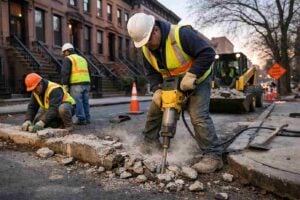
Defective flags are saw-cut at joints, broken out carefully to protect adjacent slabs, and removed. Subgrade is excavated to required depth, compacted, and leveled with approved base material. Any voids are filled and stabilized.
Step 4: Formwork and Reinforcement
Forms are set to exact grades. Expansion joint material is placed every 20 feet. In some cases, light reinforcement or fiber additives enhance strength.
Step 5: Concrete Placement
DOT-approved mix (typically 4-inch thickness) is poured, vibrated, and finished with a broom texture for slip resistance. Pigmented concrete may be used in commercial zones. Joints are tooled and sealed.
The entire process for a typical residential block of sidewalk takes 3–7 days once permits are in hand. Weather, permit backlogs, or complex root issues can extend timelines, but experienced concrete contractors in New York minimize delays by preparing documentation in advance.
Quality materials and precise execution matter. DOT specifications demand concrete compressive strength meeting highway standards, proper air entrainment for freeze-thaw resistance, and exact slope tolerances. Cutting corners risks failed inspections and repeat work.
Benefits of Hiring Licensed Concrete Contractors in New York
Choosing qualified concrete contractors in New York delivers advantages that DIY or unlicensed work cannot match:
- Compliance Guarantee — Experts know every DOT specification, code requirement, and inspection nuance, ensuring your repair passes dismissal on the first attempt.
- Warranty and Longevity — Professional installations often carry 18-month guarantees or longer, backed by proper subgrade preparation that prevents premature settling.
- Cost Efficiency — While upfront bids may seem higher than DIY, they avoid city repair surcharges, liens, interest, and rework. Typical costs range for standard concrete replacement, far less than city-billed rates.
- Liability Protection — Licensed contractors carry insurance, reducing your exposure if issues arise during or after work.
- Time Savings — They handle permits, scheduling, and 311 coordination, freeing you from bureaucratic hurdles.
- Enhanced Property Value — Smooth, compliant sidewalks improve curb appeal and signal responsible ownership to buyers or lenders.
- Safety and Accessibility — Proper ramps, slopes, and textures meet ADA standards, protecting pedestrians and shielding you from lawsuits.
When searching for sidewalk repair near me, prioritize contractors with DCWP licensing, verifiable DOT experience, recent references, and transparent bidding. Avoid low-ball offers that skip full-depth removal or proper jointing, they fail inspections.
Curb Repair Brooklyn: An Often Overlooked but Related Service
Curb repair in Brooklyn may be needed if roots, settling, or vehicle impacts have affected the transition between sidewalk and roadway.
In Brooklyn neighborhoods like Park Slope, Williamsburg, or Bay Ridge, contractors frequently coordinate with DOT for curb work. Performed at no additional owner cost when tied to sidewalk repairs. Professional teams assess curb condition early, request city involvement where eligible, and ensure seamless transitions that maintain proper drainage and pedestrian safety. Addressing curb repair Brooklyn alongside sidewalk work prevents future water infiltration and extends the life of your new concrete.
How to Find Reliable Sidewalk Repair Near Me and Sidewalk Repair Contractor NYC
Locating trustworthy sidewalk repair near me or a sidewalk repair contractor NYC starts with verification:
- Check DCWP licensing and complaint history.
- Request proof of DOT sidewalk repair experience and insurance.
- Ask for recent references and before/after photos of similar projects.
- Compare itemized bids that specify full-depth removal, subgrade compaction, concrete thickness, joint placement, and permit handling.
- Confirm they schedule the dismissal inspection.
- Read reviews on verified platforms and check for membership in local contractor associations.
Seasoned concrete contractors in New York offer free consultations, rapid response to violations, and borough-wide coverage. They understand nuances across neighborhoods, from historic brownstone blocks in Brooklyn to high-traffic avenues in Manhattan.
Preventive Maintenance: Extending the Life of Your Sidewalk
After concrete sidewalk repair NYC, proactive care prevents new defects:
- Inspect seasonally for new cracks or settling.
- Keep sidewalks clear of snow, ice, and debris.
- Address tree roots early via Parks Department coordination.
- Avoid parking heavy vehicles on sidewalks.
- Monitor drainage after heavy rains.
Protect Your Property with Expert Concrete Sidewalk Repair NYC
Concrete sidewalk repair NYC is an investment in safety, compliance, and peace of mind. Don’t wait for a notice to appear, proactive sidewalk repair new york services keep your property in top condition year-round. NYC Sidewalk Repair stands ready to deliver the compliant, durable results your property deserves. Contact a licensed sidewalk repair contractor in NYC today, schedule your free assessment, and take the first step toward violation-free sidewalks that enhance safety and value for years to come.