
In the bustling borough of Brooklyn, where millions of pedestrians navigate daily, sidewalk repair in Brooklyn stands as a critical responsibility for every property owner. Cracked, uneven, or sunken sidewalks don’t just look unsightly; they create trip hazards, invite costly lawsuits, and violate strict New York City regulations. Whether you’re dealing with tree-root upheaval in Park Slope or settlement issues in Williamsburg. Understanding sidewalk repair in NYC is essential for maintaining public safety and avoiding penalties from the Department of Transportation (DOT).
This comprehensive guide dives deep into every aspect of sidewalk repair in Brooklyn, from legal obligations and common problems to step-by-step processes, material choices, costs, and long-term maintenance. By the end, you’ll have the knowledge to act confidently, ensuring your sidewalks remain safe, compliant, and durable for decades.
Why Sidewalk Repair in Brooklyn Matters More Than Ever
Brooklyn’s sidewalks serve as the arteries of daily life. With over 2.5 million residents and countless visitors, these concrete pathways endure heavy foot traffic, harsh weather, and underground root systems. Neglecting sidewalk repair in Brooklyn doesn’t just risk a stubbed toe; it can lead to serious injuries, especially for seniors, children, and those with mobility challenges.
According to the NYC Administrative Code, property owners can be held liable for injuries caused by unsafe sidewalks adjacent to their property. A single trip-and-fall claim can cost tens of thousands in legal fees and settlements. Beyond liability, the DOT actively patrols for defects and issues violations that trigger mandatory repairs.
Sidewalk repair in NYC also supports broader community goals. Safe, smooth sidewalks encourage walking, reduce vehicle dependency, and align with Brooklyn’s sustainability initiatives. Well-maintained paths improve property values; studies show homes with pristine sidewalks sell faster and at higher prices.
Ignoring the need for sidewalk repair New York invites escalating problems. Minor cracks widen over time due to freeze-thaw cycles common i.n New York’s climate. Water seeps in, freezes, expands, and creates larger voids. Tree roots, abundant in Brooklyn’s tree-lined streets, exert tremendous upward pressure, lifting slabs by inches. Settlement from poor soil compaction or nearby construction adds to the mix. The result? Trip hazards exceeding ½ inch are flagged by the threshold DOT inspectors as dangerous.
Investing in professional sidewalk repair in Brooklyn early prevents these issues from snowballing. It demonstrates proactive stewardship, protects your family and neighbors, and keeps you compliant with evolving city codes. In short, sidewalk repair in NYC isn’t an expense; it’s an investment in safety, compliance, and peace of mind.
Legal Framework: Understanding Your Responsibilities for Sidewalk Repair in NYC
New York City places the burden of sidewalk maintenance directly on property owners under two key sections of the Administrative Code: § 19-152 (Duties and obligations of property owner with respect to sidewalks) and § 7-210 (Liability of real property owner for failure to maintain sidewalk in a reasonably safe condition).
These laws apply borough-wide, including every block in Brooklyn. Owners must keep sidewalks “in a reasonably safe condition,” free of cracks wider than ½ inch, uneven flags (slabs) differing more than ½ inch in height, missing sections, or improper slopes that cause pooling water.
When DOT inspectors identify defects during routine patrols or after complaints, they issue a Sidewalk Violation Notice. You typically receive 75 days to complete repairs, though extensions are possible with justification. Failure to act results in escalating fines, city-performed repairs billed to you (often at premium rates), liens on your property, and heightened liability exposure.
Important nuance: For one-, two-, or three-family owner-occupied homes, the city may assume responsibility for tree-root damage under specific conditions. However, commercial properties, multi-family buildings, and vacant lots remain fully owner-responsible. In Brooklyn’s mixed-use neighborhoods, this distinction matters greatly.
NYC sidewalk repair contractor work must follow DOT specifications exactly. Concrete must meet minimum strength requirements (typically 4,000 PSI), proper thickness (usually 4 inches for standard sidewalks), and precise grading for drainage (maximum 2% cross-slope). Expansion joints, scoring patterns, and ADA-compliant transitions are non-negotiable.
Permits are mandatory for any repair exceeding 25 square feet or addressing a violation. The sidewalk construction permit costs linear feet, with an additional fee for corner properties. Contractors registered with the DOT handle applications efficiently, while homeowners can apply by mail with a notarized Affidavit of Ownership.
Identifying Common Problems That Demand Sidewalk Repair Brooklyn
Brooklyn sidewalks face unique stresses. Recognizing issues early allows timely intervention before small defects become major headaches.
Cracks and Fractures top the list. Freeze-thaw cycles, water entering pores, freezing, and expanding, cause hairline cracks to widen. Thermal expansion from summer heat exacerbates this. Heavy pedestrian or occasional vehicle loads add stress. In older Brooklyn blocks with 100-year-old concrete, cracks often signal underlying base failure.
Uneven Surfaces and Trip Hazards arise from soil settlement, poor original installation, or root uplift. A ½-inch vertical displacement qualifies as a trip hazard under DOT standards. Tree roots from street maples or London planes are notorious culprits in neighborhoods like Prospect Heights and Ditmas Park.
Sunken or Depressed Slabs result from erosion beneath the concrete or compaction issues. Water pooling in low spots accelerates deterioration and creates slip hazards during rain or winter.
Broken or Missing Sections occur from impact, age, or utility work. Exposed rebar or sharp edges pose immediate dangers.
Improper Drainage and Ponding violates code and accelerates all other damage. Sidewalks must slope away from buildings at ¼ inch per foot minimum.
Other issues include spalling (surface flaking), discoloration from de-icing salts, and heaving near curb lines.
To inspect your own sidewalk, use a straightedge or level. Measure vertical differences and crack widths. Document everything with photos and dates, valuable if disputes arise. However, professional assessment by a nyc sidewalk repair contractor ensures nothing is missed, especially subsurface problems invisible to the untrained eye.
Early detection through regular checks (twice yearly, plus after severe weather) prevents 80% of major repairs. Addressing concrete repair in Brooklyn promptly extends sidewalk lifespan from 20-30 years to 50+ with proper techniques.
The Step-by-Step Process of Professional Sidewalk Repair Brooklyn
Executing sidewalk repair Brooklyn correctly requires precision and adherence to DOT protocols. Here’s the detailed process trusted contractors follow:
- Initial Assessment and Violation Review Review any DOT notice. Measure defects precisely. Determine if full slab replacement or partial patching suffices. For violations, full replacement of affected flags is standard.
- Contractor Selection and Licensing Check Hire a DCWP-licensed Home Improvement Contractor and DOT-registered for permits. Verify insurance, references, and Brooklyn-specific experience.
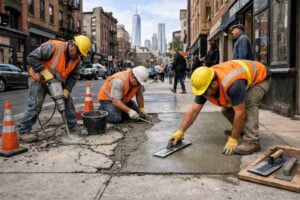
- Site Preparation Barricade the area with proper signage and fencing per DOT rules. Remove old concrete using jackhammers or saws. Excavate to stable subgrade. Install or repair gravel base (minimum 4-6 inches compacted). Address any root issues carefully, cutting roots requires arborist consultation to protect trees.
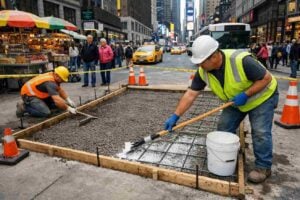
- Formwork and Reinforcement Install wooden or metal forms matching existing lines. Place expansion joints every 5-6 feet. Add wire mesh or fiber reinforcement for crack resistance in high-traffic areas.
- Final Inspection and Violation Dismissal Schedule DOT dismissal inspection within days of completion. Provide documentation. Once approved, the violation is cleared, critical for compliance records.
This methodical approach ensures concrete repair Brooklyn meets or exceeds standards.
Choosing the Right Sidewalk Repair Contractor Brooklyn
Selecting a qualified sidewalk repair contractor Brooklyn separates successful projects from nightmares. Look for:
- Licensing and Registration: Department of Consumer and Worker Protection (DCWP) Home Improvement Contractor license and DOT sidewalk permit registration.
- Insurance: Minimum $1 million liability and workers’ compensation.
- Experience: Proven track record in Brooklyn neighborhoods, handling historic districts or tree-heavy blocks.
- References and Reviews: Check recent Brooklyn projects and BBB ratings.
- Transparent Pricing: Written estimates detailing scope, materials, timeline, and permit fees.
One trusted option is NYC Sidewalk Repair, a company with deep expertise in local regulations and quality workmanship.
Avoid low bidders who cut corners on base preparation or use substandard mixes. Reputable contractors educate clients on timelines (typically 1-2 weeks for standard jobs) and coordinate with utilities or landmarks preservation in historic areas.
Concrete Repair Brooklyn: Materials, Techniques, and Innovations
Concrete repair Brooklyn has evolved. Modern techniques prioritize durability and sustainability.
Standard sidewalk concrete uses 4-inch thickness with 4,000-5,000 PSI strength. Air-entrainment additives resist freeze-thaw. Fiberglass or steel fibers reduce cracking.
Techniques vary by damage:
- Full Slab Replacement: Most common for violations. Remove entire flag, prepare base, pour new.
- Partial Patching: For small cracks, cut out damaged area, bond new concrete.
- Leveling (Mudjacking or Polyurethane Foam Injection): Lift sunken slabs without full removal, cost-effective for minor settlement.
- Crack Sealing: Epoxy or polyurethane injection for hairline cracks before they widen.
Innovations include pervious concrete for better drainage in flood-prone areas and recycled aggregate mixes supporting Brooklyn’s green goals.
Proper curing, keeping concrete moist for 7 days, prevents surface cracking. Quality concrete repair company in brooklyn ensures these details, delivering sidewalks that withstand decades of use.
Understanding the Costs of Sidewalk Repair in New York
Budgeting for sidewalk repair new york requires realistic expectations. In 2026, Brooklyn, costs reflect material inflation, labor rates, and regulatory compliance.
Factors influencing price:
- Scope and Size: Larger areas spread fixed costs (permits, mobilization).
- Accessibility: Tight Brooklyn streets or historic districts add complexity.
- Tree Roots: Require extra excavation or barriers.
- Finishes: Decorative stamping or coloring increases costs 20-30%.
- Urgency: Rush jobs or winter work command premiums.
Permit fees and any utility adjustments are additional. Licensed NYC sidewalk repair contractor quotes include these transparently.
Compare quotes from at least three providers. The lowest bid often skips proper base compaction or uses thinner concrete, leading to premature failure. Investing in quality concrete repair in Brooklyn saves money long-term by avoiding repeat repairs.
Ensuring ADA Compliance During Sidewalk Repair Brooklyn
The Americans with Disabilities Act (ADA) mandates accessible sidewalks. During sidewalk repair Brooklyn, compliance is mandatory.
Key requirements:
- Clear Width: Minimum 36 inches (60 inches preferred for passing).
- Cross Slope: Maximum 2% (1:50).
- Running Slope: Matches street grade or meets ramp standards if steeper.
- Surface: Firm, stable, slip-resistant (broom finish qualifies).
- Detectable Warnings: Truncated domes at curb ramps and crossings.
- Vertical Changes: No abrupt rises over ¼ inch; beveled edges for ¼–½ inch.
In Brooklyn’s varied terrain, achieving these slopes requires precise grading during pour. Experienced sidewalk repair contractor Brooklyn integrates ADA elements seamlessly, often adding ramp transitions at driveways or corners.
Non-compliant repairs trigger additional violations or accessibility lawsuits. Proactive inclusion of ADA features during routine concrete repair in Brooklyn future-proofs your sidewalk.
Permits, Inspections, and Timeline for NYC Sidewalk Repair Contractor Work
Permits are non-negotiable. The sidewalk construction permit covers administrative oversight and ensures public safety. Corner properties pay extra due to dual-street impact.
Applications require:
- Property details and owner affidavit (for DIY)
- Contractor registration number
- Detailed scope and drawings
- Traffic control plan if sidewalk closure exceeds thresholds
Processing: 2-3 business days standard; longer in historic districts requiring Landmarks Preservation Commission approval.
Post-repair, request a dismissal inspection immediately. DOT typically responds within days. Provide photos, permit copy, and contractor documentation.
Timelines:
- Violation notice to completion: 75 days standard.
- Actual work: 3-10 days depending on scope.
- Full process with permit and inspection: 2-4 weeks.
Delays from weather, utilities, or material shortages are common, plan buffer time. Professional nyc sidewalk repair contractor teams coordinate efficiently, minimizing disruption.
Preventive Maintenance: Extending the Life of Your Brooklyn Sidewalk
Prevention beats repair. Implement these habits:
- Inspect biannually and after storms.
- Clean debris and salt residue regularly.
- Seal cracks immediately with flexible caulk.
- Trim tree roots near sidewalks (with arborist).
- Ensure proper drainage, clear gutters and downspouts.
- Apply de-icers sparingly; use sand or calcium magnesium acetate instead.
Annual professional walkthroughs by a concrete repair company in brooklyn catch issues early. Budget yearly for maintenance versus thousands for full replacement.
Environmental and Sustainability Considerations in Concrete Repair Brooklyn
Modern sidewalk repair Brooklyn embraces sustainability. Recycled concrete aggregate reduces landfill waste. Pervious concrete allows water infiltration, easing Brooklyn’s stormwater burden and reducing flooding.
Low-carbon mixes and local sourcing cut emissions. Some contractors offer permeable paver alternatives in non-ADA sections, though traditional concrete remains DOT standard for durability.
Choosing eco-conscious sidewalk repair contractor Brooklyn aligns personal responsibility with city-wide green initiatives.
Conclusion
In every Brooklyn neighborhood, from vibrant DUMBO lofts to quiet Marine Park homessidewalk repair plays a pivotal role in daily safety. By understanding regulations, recognizing problems early, following professional processes, and maintaining diligently, you contribute to a safer, more walkable borough. Sidewalk repair in NYC ultimately protects people, property, and peace of mind. Don’t wait for a violation or accident. Assess your sidewalks today and partner with qualified experts when needed. Safe, compliant sidewalks aren’t just code; they’re a cornerstone of Brooklyn living.
For those seeking trusted guidance on sidewalk repair contractor Brooklyn or concrete repair Brooklyn, remember that expertise and compliance deliver lasting results. Prioritize quality, and your sidewalks will serve generations safely.